
Android devices shaped around your software, and securely maintained while they are in service.

We hold the root of trust on our own hardware and maintain our own Android and kernel lifecycle. That is why our devices keep receiving security updates long after the rest of this market has stopped.

$100 per device · no minimum · cancel any month

Why they stay secure

We control the parts that decide whether a device can be fixed

  1. Strict control over what runs

    Every piece of software on the device is cryptographically verified before it starts, and limited to what the customer has selected.

  2. We replaced the parts we could not trust

    The chip maker's security code is closed and rarely updated. We replaced the most sensitive pieces with modern versions that are heavily audited and widely trusted.

  3. We keep it up to date, over the air

    Devices that left the factory on Android 13 run Android 17 today. Updates reach devices that are already deployed, and a bad update undoes itself.

Proof

A video call can take over millions of Android phones. There is still no fix.

Researchers found this in a chip family used across budget phones from Motorola, Xiaomi and Realme. The chip maker never answered them. This is typical, not rare: more than 40% of Android devices in the world no longer receive security updates at all.

We patched the modem ourselves, made sure it cannot change the kernel's code, and hardened the interface between them.

Read the bulletin

13 → 17Android versions
Four major Android versions of security fixes, on hardware the factory stopped updating.
1 weekCritical fixes
Our commitment for critical security fixes.
1Minimum order
Start with a single device and add more when you are ready.

Capabilities

What our devices can do that others cannot

Talk directly to plugged-in equipment

Scales, medical instruments, industrial controllers, payment terminals, sensors. Ordinary Android blocks an app from reaching them, so these products cannot be built on a typical tablet.

Your app controls the device

Ordinary Android keeps an app locked in a sandbox. On our devices your app can change device settings, manage network and power, lock the screen to one app, reboot on a schedule, install its own updates, and keep running instead of being shut down to save battery.

Your own server can verify a device before trusting it

Each device proves, in hardware, that it is a genuine OhrTech device running exactly the software you approved.

What we own

We build and maintain the operating system, on our own hardware

  • Root of trust. Our signing key is burned into each device. No one else can sign software it will run.
  • Secure execution. We replaced the chip vendor's closed security code with Trusty, Android's open, audited reference implementation.
  • Bootloader and updates. Verified boot with two system slots, so an update installs beside the running system and a failed one rolls back.
  • Android and kernel. Our own lifecycle, not the chip vendor's schedule.
  • Hardware. We work directly with the board manufacturer and specify our devices ourselves, starting with a 4G band set enlarged for global coverage. It is also how we build custom devices for customers who need them.

See the device

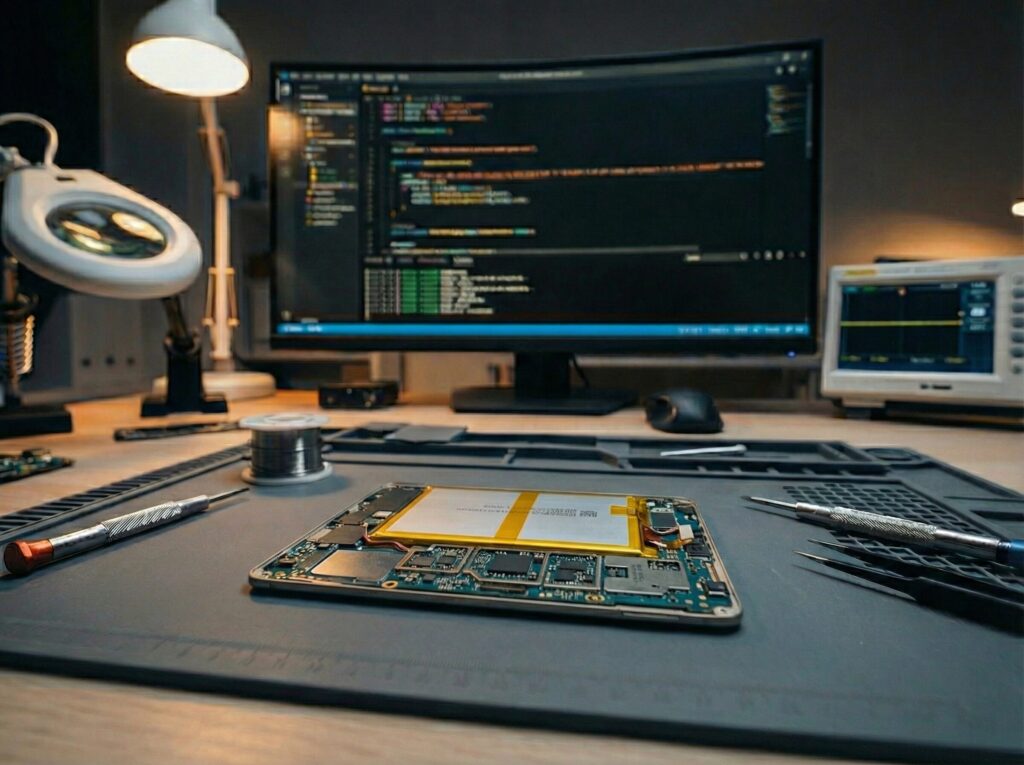
An opened tablet on an electronics workbench, with source code on the monitor behind it

Security bulletins

What we have fixed lately

OHR-2026-014

System WebView zero-day (CVE-2026-125350): fixed

A flaw in how the Chromium web engine handles XML lets a crafted web page run code inside the engine's sandbox. Google reports it is being exploited in the wild. It affects every Android app that shows web content through a WebView older than Chromium 157.0.8103.50. We updated the WebView on OhrTech devices on November 11, 2026, two days after Google's fix.

HighFixedCVE-2026-125350CVE-2026-125346
OHR-2026-013

November 2026 Android security update: applied November 7

Google's November 2026 Android Security Bulletin lists 118 vulnerabilities in Android, six of which Google rates critical. We applied the fixes on November 7, 2026, had already fixed the most severe image flaw on October 30, and completed the last fix, in the bootloader's own copy of the verified-boot code, on November 11. OhrTech devices are at security patch level 2026-11-05. There is no known exploitation.

CriticalFixedCVE-2026-58868CVE-2026-58876CVE-2026-58936CVE-2026-58984CVE-2026-58814CVE-2026-58956CVE-2026-58978
OHR-2026-012

Brotli decompression flaw (CVE-2026-111497): fixed

A flaw in Google's Brotli decompression library lets a crafted compressed stream corrupt memory in the program that decodes it. It is being actively exploited against servers, and on Android a crafted image can use it to corrupt memory in the app showing it. We fixed it in the Foundation OS ten days after Google published it.

HighFixedCVE-2026-111497

Start with one device.

$100 per device, then $10 a month, with the SDK, hardware attestation and hardening options included. No minimum, no sales call, cancel any month.